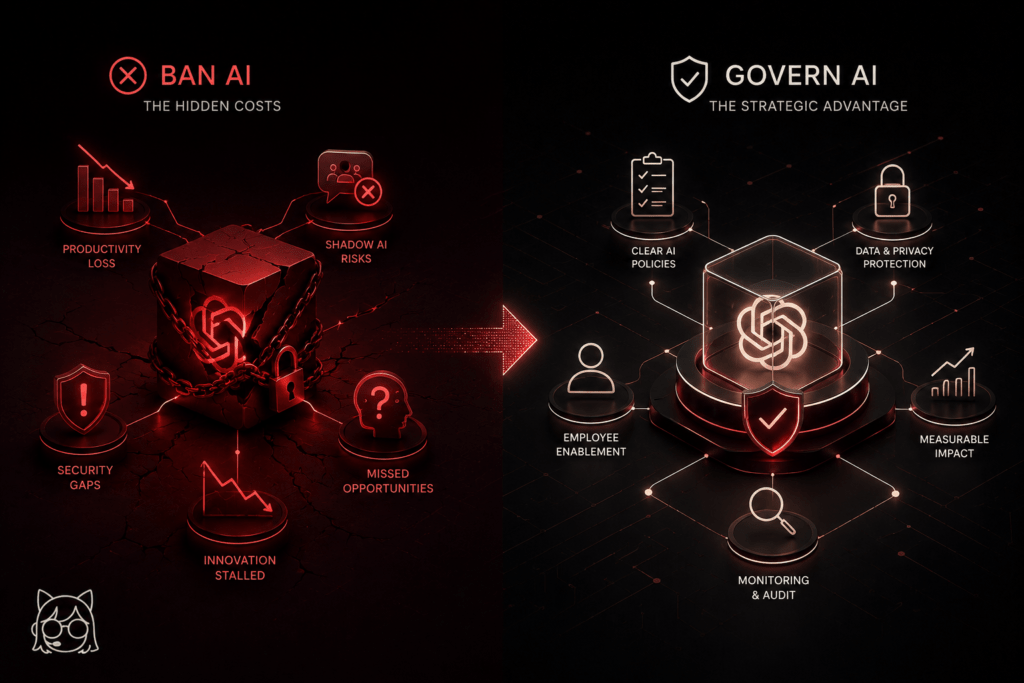
Banning ChatGPT is one of the most common first responses when AI governance concerns reach board or leadership level. Block it at the network level. Prohibit consumer AI platforms. Issue a policy statement that staff should not use AI tools for work until further notice.
It feels like a decisive governance response. In practice, it rarely produces the outcome it is meant to achieve, and it often makes the underlying governance problem considerably harder to address.
What banning ChatGPT actually achieves
A network-level block on a specific AI platform stops that platform being accessible on corporate networks via corporate devices. It does nothing about personal devices, mobile data, or the dozens of alternative platforms offering similar capabilities that the block does not cover. It also does nothing about AI features already embedded in the SaaS platforms the organisation has approved and cannot block without disrupting core operations.
What a ban reliably achieves is a change in behaviour at the margin. Staff who were using AI openly, because they did not realise it was a governance concern, stop. Staff who were using it because it is genuinely useful find alternatives. In practice, the effect is to push the most capable and motivated AI users – often the people creating the most operational value from AI adoption – toward less visible channels.
The organisation has not reduced AI usage. It has reduced visible AI usage, which is a very different thing. From a governance perspective, visible usage that can be understood and controlled is significantly preferable to invisible usage that cannot.
The signal a ban sends
Beyond the practical ineffectiveness, banning ChatGPT sends a signal about organisational culture with real consequences for talent and operational capability.
AI literacy is becoming a professional skill people invest in and value. Staff who find their organisation’s response to AI is prohibition rather than governance often conclude the organisation is behind the curve, and that conclusion is not entirely wrong. In competitive talent markets, organisations seen as obstacles to professional development with important tools lose people to those that are not.
There is also a credibility problem. A blanket ban is often read by staff as evidence that leadership does not trust their judgement, does not understand AI well enough to make nuanced governance decisions, or is prioritising the appearance of governance over its substance. None of those readings encourages the collaborative approach that actually works.
What the ban-and-monitor pattern reveals
Organisations that ban ChatGPT and then monitor compliance, formally or informally, tend to discover the same thing: the ban has less effect on actual AI usage than it appeared to from a governance perspective.
Staff find workarounds quickly, and the workarounds are often less secure than the original usage, because they involve personal devices, personal accounts, and tools the organisation has no relationship with, rather than tools that at least had visible usage the governance function could observe.
The monitoring also reveals something useful: the use cases people were willing to work around a policy to access. Those use cases represent genuine operational needs that governance has failed to address. A ban that generates significant circumvention is telling the organisation something important about the gap between its official AI position and its operational reality – a gap worth addressing rather than policing.
The governance response that works instead
The alternative to banning ChatGPT is not ungoverned adoption. It is governed adoption: a clear framework of approved tools, clear guidance on what data can go where, a fast approval process for new tools, and genuine monitoring of whether the framework is working, in the spirit of secure AI adoption without killing productivity.
This approach takes more governance investment than a ban. It means understanding what tools are being used and why, building an approved list that genuinely meets operational needs, and creating the processes and communication that make the right behaviour easy. It is harder than saying no.
But it produces something a ban cannot: an organisation that actually knows what AI is in use, has made deliberate decisions about what is acceptable, and has governance that reflects operational reality rather than a theoretical position staff work around. Organisations that have moved through the ban phase and built genuine governance tend to look back on the ban as a delay rather than a solution, a response that felt decisive and turned out to be a detour from the governance work that needed to happen anyway.
Black Chili’s Continuous AI Assurance service helps organisations build the ongoing governance framework that makes safe AI adoption possible without relying on restriction.
If you are not sure what AI tools are in use inside your organisation, an AI Exposure Review gives you a clear, independent picture - what is being used, what data it touches, and where the real risks are.