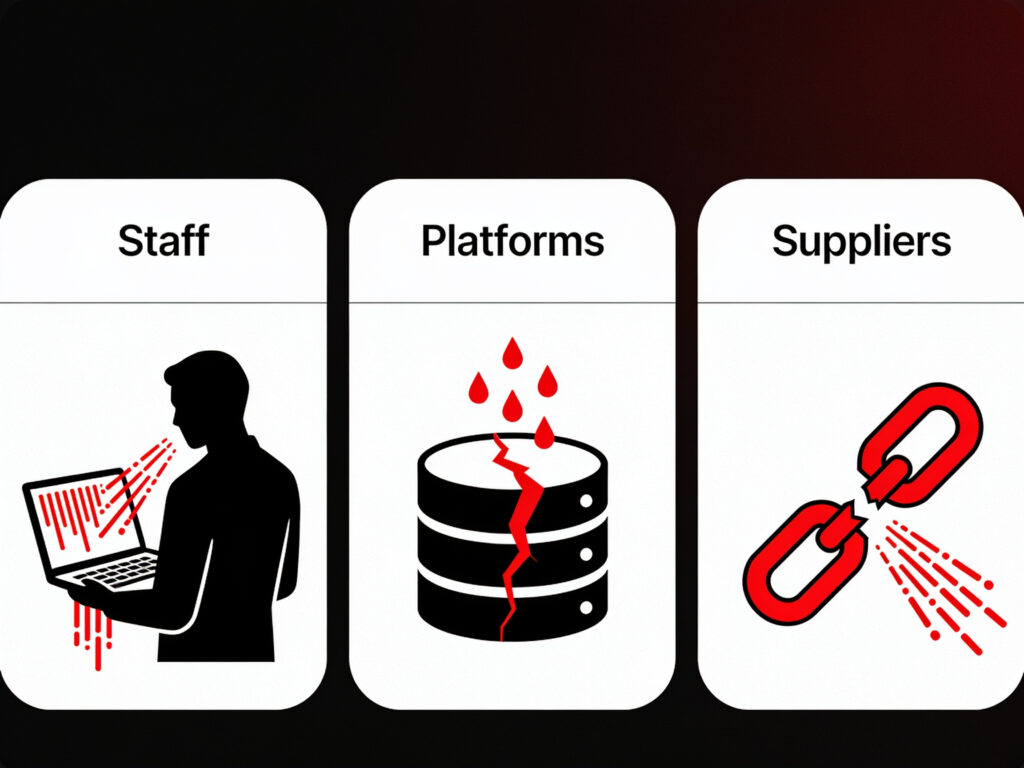
AI data leakage rarely looks like a breach. It does not arrive with a system alert or a notification from a supplier. It looks like normal work – a staff member using a tool that helps them do their job faster, in a way that happens to create exposure the organisation would not have sanctioned if anyone had thought to ask.
That ordinariness is what makes AI data leakage both common and easy to underestimate. The scenarios below are not hypothetical. They are patterns that appear consistently across organisations of different sizes and sectors when AI governance is examined honestly.
Pasting sensitive content into public AI tools
This is the most common AI data leakage scenario, and it happens across every business function. A member of staff uses a public large language model to help draft, edit, summarise, analyse, or improve a piece of work. The content they paste in contains information the organisation would not want to share externally – a client’s personal data, commercial terms from a negotiation, internal financial projections, an employee’s HR records, source code from a proprietary system.
The staff member does not think of this as sharing data externally. They think of it as using a tool. The distinction that matters for governance – that the content has left the organisation’s control and is now being processed by a supplier under terms that may permit retention and further use – is invisible to them in the moment.
The exposure this creates varies considerably depending on the tool and its terms. Enterprise AI tools, such as Anthropic’s Claude Enterprise, typically come with stronger contractual protections around data handling and do not use customer prompts to train models by default. Many consumer-facing tools, particularly free-tier offerings, have terms that permit retention of submitted content and its use for model improvement. That difference matters, and it is not visible to staff without clear, specific guidance.
AI features in existing platforms handling unexpected data
A significant and frequently overlooked category of AI data leakage involves AI features embedded in platforms the organisation already uses. These features process data that flows through the platform as part of normal operation, often without staff making any deliberate decision to submit data to an AI system.
A project management platform with AI summarisation processes the content of tasks, comments, and documents. A CRM with AI-powered contact analysis processes customer communications and relationship data. A communication tool with AI note-taking generates transcripts of meetings that contain sensitive discussions. An email client with AI assistance processes message content to generate suggestions.
In each case, nobody is submitting data to an AI tool by deliberate choice. An AI feature is processing it as part of the normal functioning of a platform the organisation has already sanctioned. Whether the existing data processing agreements with those suppliers cover the AI features – and under what terms the AI-processed data is handled, retained, and potentially used – is a question most organisations have not answered. This is the same embedded AI gap covered in the hidden supplier risks in enterprise AI.
Browser extensions with broader access than expected
AI-powered browser extensions present a distinct AI data leakage risk that is easy to overlook during adoption. Extensions request permissions at installation, and those permissions are typically accepted without detailed review. Many AI browser extensions request access that extends well beyond the specific functionality being sought.
Common permissions requested by AI browser extensions include access to content on all websites visited, access to clipboard data, access to browsing history, and in some cases access to stored credentials or form data. An extension adopted to improve writing quality or summarise web content may, in practice, have visibility across a much broader range of activity than the staff member adopting it realised.
When those extensions are used alongside authenticated business applications – logged-in SaaS platforms, internal systems accessible via browser, business email and calendar – the scope of what the extension can potentially access and transmit is materially wider than the specific task it was adopted for.
AI-generated content used without adequate review
AI data leakage is typically framed as organisational data going somewhere it should not. A related but distinct risk involves AI-generated content entering the organisation’s outputs without adequate review, creating exposure through what the organisation produces rather than through what it submits.
AI tools generate plausible-sounding content that is sometimes inaccurate, occasionally fabricated, and in some configurations capable of reproducing content from their training data in ways that raise intellectual property questions. When AI-generated content is used in customer communications, regulatory submissions, legal documents, financial analysis, or other contexts where accuracy is critical, failing to review it adequately creates liability that has nothing to do with data submission and everything to do with content quality and accountability.
The governance requirement here is clear accountability for human review of AI-generated outputs before they are relied upon or communicated externally. That accountability needs to be explicit rather than assumed, and it needs practical guidance about what adequate review looks like for different categories of output – the same point covered in what should an AI acceptable use policy cover.
Supplier-side changes that shift the data handling position
A final and particularly difficult AI data leakage scenario involves supplier-side changes that alter the data handling position without the organisation taking any action. A supplier updates their privacy policy or terms of service to expand their rights around data usage. An AI platform changes its approach to prompt retention. A tool that previously operated under robust enterprise terms reduces those protections as part of a change to its commercial model.
The organisation’s data handling practices have not changed. The exposure has. Without a supplier monitoring process that catches these changes and triggers a governance review, the organisation may continue operating under the assumption that its original assessment remains valid, long after it has become inaccurate.
This is one of the more insidious categories of AI data leakage precisely because it requires no action by staff and no failure of governance processes. It requires only the absence of the ongoing supplier monitoring covered in how to onboard AI tools safely.
If you want to understand your organisation’s actual AI data leakage exposure rather than the theoretical risk, Black Chili’s AI Incident Review service provides the structured independent assessment you need.
If you are not sure what AI tools are in use inside your organisation, an AI Exposure Review gives you a clear, independent picture - what is being used, what data it touches, and where the real risks are.