Selected work / Cloud architecture

A secure AWS application platform.
Designed around the business.

A secure AWS application platform is not a pile of Amazon services. It is a set of decisions about availability, customer information, access, recovery and who responds when something goes wrong.

This representative design is based on patterns we have delivered for real applications. Customer-specific implementation details have been removed. The important part remains: a platform built to protect the service as it grows.

Fewer single points of failureTraffic distribution, managed services and recovery designed in.
Security at every layerEdge protection, segmentation, identity, workload and data controls.
Operable after launchMonitoring, response, patching, backups and accountable ownership.
The problem behind the diagram

Why a secure AWS platform matters as applications grow.

A web application can begin on a single server and work perfectly well. Growth changes the risk. More customers depend on it. The information becomes more valuable. Downtime becomes visible. A compromised account or unpatched server can affect the whole business.

The solution is not cloud for its own sake. It is an operating design that separates responsibilities, limits exposure and makes failure manageable.

A representative platform

A secure AWS request path and a controlled operational foundation.

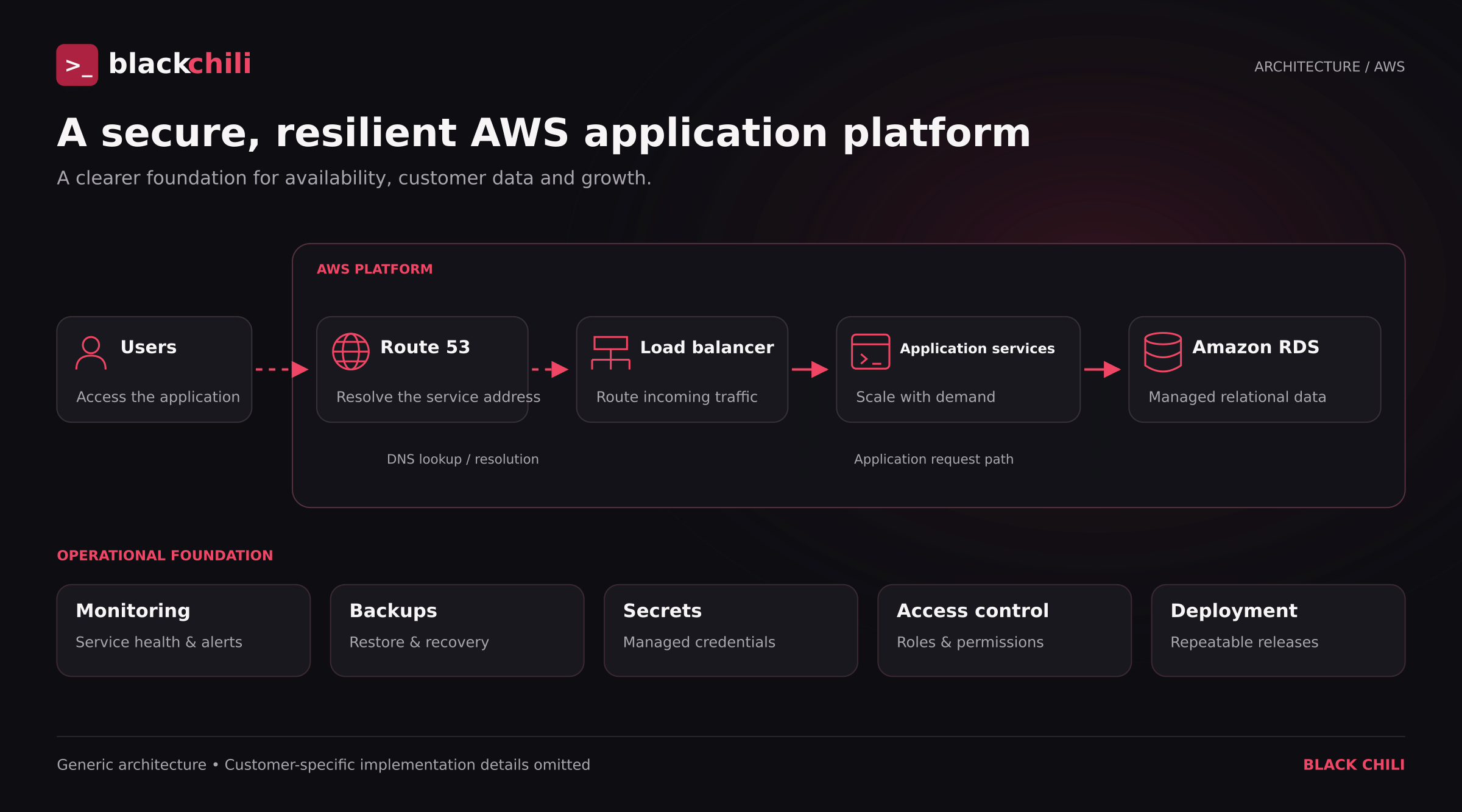
The public path is deliberately simple. Users reach a protected service address, traffic is filtered and distributed, application workloads process the request, and managed data services hold persistent information. The controls around that path make it dependable.

Secure AWS application platform with Route 53, load balancing, application services, Amazon RDS and operational controls
Generic architecture. Customer-specific implementation details are deliberately omitted.

In plain English

What happens when a customer uses the service?

01Find the service

Route 53 directs the customer to the correct protected endpoint.

02Filter the request

A CDN and web application firewall absorb common attacks and reduce unnecessary load.

03Distribute traffic

The load balancer directs healthy requests to available application capacity.

04Run the application

Services operate in restricted network segments and scale to meet demand.

05Protect the data

Managed databases remain private, encrypted, backed up and accessible only to authorised services.

Security by design

Secure AWS architecture treats security as part of the platform.

A secure AWS design does not depend on a single product. Protection comes from several controls that assume another layer may fail.

The exact services depend on the application, regulatory needs, existing IT arrangements and budget. The control objectives do not change.

The design draws on the AWS Well-Architected Security Pillar, the protection capabilities documented for AWS WAF, and the division of duties described by the AWS shared responsibility model.

Edge and application protection

CDN delivery, TLS, DDoS resilience, WAF rules, rate limiting and controlled origin access reduce exposure before traffic reaches the application.

Network segmentation

Public entry points are separated from private application and data tiers. Security groups allow only the required paths between components.

Identity and RBAC

Roles separate administration, deployment, support and service access. Least privilege, MFA and managed credentials reduce the value of a stolen account.

Workload protection

EC2 workloads can use EDR, anti-malware, vulnerability scanning, hardened images and controlled patching. Internet access and administrative paths remain restricted.

Data security and recovery

Encryption, managed secrets, private database access, protected backups and tested restore procedures defend both confidentiality and availability.

Controls that work together

Designed to reduce exposure and shorten recovery.

◎

CDN and WAF

Static content is served close to users while malicious and abnormal web requests can be blocked before they reach the application.

⌁

Segmented networks

Only the load balancer is intended to accept public application traffic. Workloads and databases remain in private tiers with explicit communication rules.

◆

Role-based access

People and services receive the access required for their role. Privileged operations are separated, logged and protected with stronger authentication.

✦

EDR and anti-malware

Where servers are managed directly, endpoint controls provide behavioural detection, malware prevention and evidence for investigation alongside hardened configuration.

↻

Vulnerability management

Operating systems, dependencies and external services are assessed on an agreed cadence. Findings are prioritised, remediated and re-tested.

▣

Logs and evidence

Application, identity, network and security events are centralised with useful retention, alerting and access controls. Logs support action rather than merely existing.

Security operations

A platform needs someone watching it.

Central monitoring can feed an internal team, an existing provider or a managed SOC service. We can help define the events, escalation routes and response responsibilities, then bring in 24-hour monitoring where the risk and business requirement justify it.

Central loggingActionable alertsSOC integrationIncident escalationResponse evidence

An operating model, not a handover folder

Security continues after go-live.

The design establishes the controls. The operating model keeps them effective as applications, threats and business priorities change.

Monitor

Collect service, identity, network and security signals.

Detect

Turn relevant changes and behaviours into useful alerts.

Triage

Establish what happened, what is affected and how urgent it is.

Contain and recover

Limit harm, restore service and preserve the evidence needed.

Improve

Apply lessons to architecture, controls, runbooks and priorities.

A containerised alternative

Same security objectives. A different compute model.

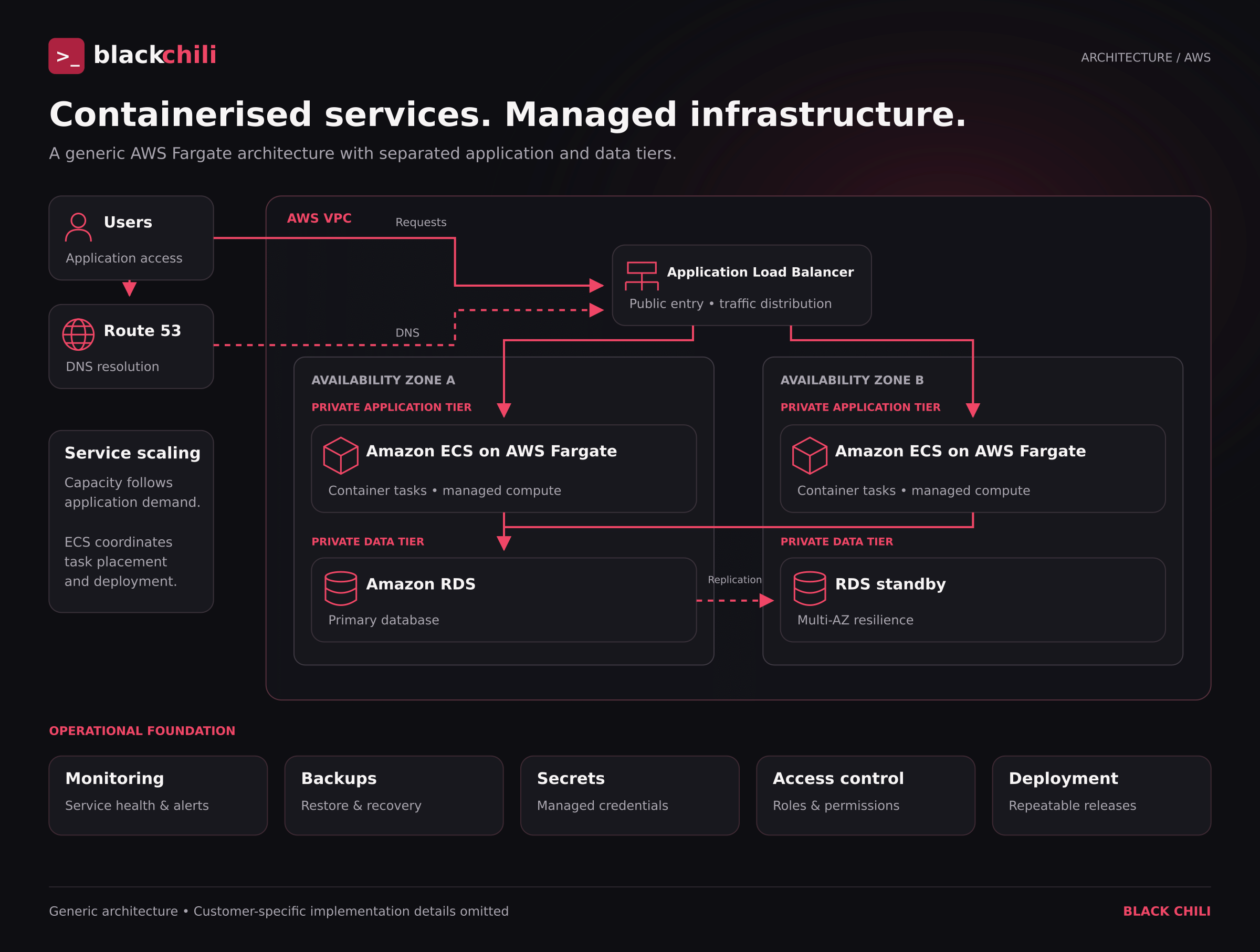
For services suited to containers, Amazon ECS on AWS Fargate can remove routine server management and place application tasks across availability zones. Private application and data tiers, load balancing, role-based access and managed recovery remain central to the design.

Containerisation changes the workload controls. Security moves towards trusted base images, image and dependency scanning, signed deployment artefacts, short-lived tasks, runtime monitoring and restricted task roles. Conventional endpoint antivirus is not simply copied into each Fargate task.

This can reduce operational burden, but it does not remove the need for secure configuration, monitoring, vulnerability management or incident response.

Managed EC2

  • Greater host-level control
  • Suitable for traditional or specialist workloads
  • EDR, AV and patching applied to the instances
  • More operating-system responsibility
AWS Fargate architecture with private application and data tiers across two availability zones
A generic multi-availability-zone Fargate design. The right choice depends on the workload and operating model.

Where this pattern fits

For applications that have become important to the business.

This secure AWS pattern suits customer portals, SaaS products, line-of-business applications and digital services that need a clearer foundation for availability, security and growth.

It is not a fixed bill of materials. We adapt the design to the application, information, support model, recovery expectations and proportionate risk.

Start with the service, not the cloud bill

Design the platform your business can depend on.

Tell us what the application does, who relies on it and what would happen if it failed or was compromised. We will help turn those requirements into a secure, operable design.